Blog · 9 min read
Soundproofing plastic
windows

Why street noise gets through your windows and which glazing, profile and seals actually make a room quieter. Practical checks before you order.
OKNA PLAST builds plastic windows for street-facing flats in Almaty, and soundproofing plastic windows starts with three layers: a thicker insulating unit, a multi-chamber profile and a tight GOST installation. We pick the unit and profile for your noise level, then fit the window turnkey with sills and slopes the same day.
Why street noise gets through soundproofing on plastic windows
Street noise in a closed flat is rarely a single fault — sound enters by three routes, and soundproofing plastic windows fails in its own way at each.
Three paths sound takes into a flat
Street noise reaches a closed room by three separate routes — the glazing, the gap around the sash and the mounting joint between frame and wall — and fixing only the first leaves the other two open. Airborne traffic rumble is low-frequency, so it slips through the thinnest opening it can find rather than the widest. The double-glazed pane passes vibration across its panes, the gasket leaks at the handle side once it hardens, and the joint acts as a bridge wherever foam sits without a sealed vapour-tight layer. A hairline gap at the reveal can leak more sound than a whole square metre of ordinary two-chamber glazing, because rigid surfaces meeting loosely transmit low tones almost unhindered. Before ordering anything new, walk the perimeter with a lit candle on a windy evening — the flame that flickers marks the path worth sealing first.
Why a new window can still let noise in
We often find a recently fitted window leaking sound because the sash was never adjusted to a firm seal, the mounting joint was foamed without a proper vapour-tight layer, or the glazing was chosen for heat rather than noise. A wide two-chamber unit with thin 4 mm panes can transmit more low-frequency traffic rumble than a narrower one built around thicker glass. On our fittings we check sash compression against the gasket contours at three points and re-tension the hardware before handover, since a seal that closes loosely from day one hardens into a permanent leak within a couple of seasons. A window rated for warmth is not automatically quiet. If you hear the street through a window fitted a season ago, ask for a compression check and a look at the reveal before considering a new unit.
What actually blocks sound in a window
Quiet comes from the glazing first, then the profile and its seals. The numbers that matter are millimetres of pane, chambers in the frame and the decibels the profile is rated for.
Glass thickness and chambers that matter for quiet
For street noise the useful starting point is 6 mm panes instead of the standard 4 mm, and a two-chamber build whose air gaps differ in width so they do not resonate at the same frequency. Pane thickness for quiet is not a matter of one heavy sheet alone — the spacer between panes sets how the cavity behaves. A 4-12-4-12-4 build carries 4 mm panes and equal gaps; a 6-14-4-16-6 layout pairs heavier outer sheets with unequal spacers, and the traffic band around 100–500 Hz loses roughly 5–8 dB by comparison. Acoustic performance is measured on the whole assembly, not the profile, so the build decides most of the result. Two identical air gaps can amplify a narrow band of traffic noise, so unequal spacers usually sound calmer than a heavier build with matching gaps.
Thick glass or laminated glass
Laminated glass with a sound-damping interlayer usually outperforms a single thicker pane at the same total weight, because the soft layer absorbs vibration that rigid sheets pass on. A 6.4 mm laminated pane — two 3 mm sheets bonded through a 0.4 mm acoustic film — damps the mid frequencies of engines and trams better than a plain 8 mm sheet of the same mass. In a two-chamber build the laminate goes on the street-facing side, where the sound hits first. The interlayer also holds fragments in place, so a laminated pane near a busy road adds a safety margin without changing the frame depth, and it fits the same rebate as standard glazing. Ask for the acoustic film, not the plain safety one — the damping grade is what cuts the rumble.
Profile chambers and seals compared
| Profile | Chambers | Rated sound insulation | Seal contours |
|---|---|---|---|
| Salamander bluEvolution | 6 | up to 48 dB | multi-contour |
| KBE 76 mm | 6 | up to 46 dB | multi-contour |
| WDS 6S | 5 in sash, 7 in frame | up to 36 dB | standard |
| Rehau Geneo | multi | glass up to 52 mm | 3 contours |
How to make windows quieter without replacing the whole window
Before ordering anything, it helps to know which fixes you can do yourself and which need a fitter with a gauge, the right glass thickness for quiet, and a thicker glass unit.
Checks you can do yourself
- Paper test: close the leaf on a sheet of paper and pull it free; if it slides out easily, the gasket is not gripping.
- Candle test: hold a flame near the reveal on a windy day; a flicker marks exactly where air and sound slip in.
- Gasket check: run a finger along the rubber for hard, flattened or cracked spots.
- Handle check: turn it fully and feel for resistance; a loose fitting means weak compression.
- Joint check: look for gaps or cracks in the plaster where the frame meets the wall.
When a fitter and a new glass unit are needed
We swap just the glazing without touching the frame when the profile is sound, and a fitter can usually finish the job in one visit once the panel is made to size. A thicker or laminated pane adds mass along the noise path, while the leaf keeps its original hardware and gaskets. Replacement only makes sense if the frame and seals are healthy — when the mounting joint is open or the profile is warped, fresh glazing will not give you the quiet you expect. In our practice the seam is the usual culprit on upper floors of blocks facing a busy avenue, where wind pressure works on it year after year. If the checks point to worn rubber or a dropped leaf, we start with adjustment and fresh seals; if the pane is simply too thin for the street, we measure the opening and order a panel to size.
Choosing a glass unit and profile for your noise level
The right choice depends on where you live — a quiet courtyard, a mid-block street or a first-floor flat on a busy road each call for a different build.
Matching the unit to your street
| Situation | Build | Pane | Notes |
|---|---|---|---|
| Quiet courtyard | single-chamber | 4 mm | basic comfort |
| Side street | two-chamber | 4-6 mm | unequal air gaps |
| Main road, upper floor | two-chamber | 6 mm | thicker outer pane |
| First floor on a road | two-chamber | 6 mm + laminated | damping interlayer |
Reading the decibel figures
The figures to compare are the rated sound insulation of the profile and the Rw index of the glazed assembly, and a higher number means more of the street is kept out. Profile makers publish their own ratings — Salamander bluEvolution reaches up to 48 dB, KBE 76 mm up to 46 dB, WDS 6S up to 36 dB — while Rw describes the whole assembly, not the frame alone. A build around a 6 mm outer pane with a laminated inner pane scores higher than a standard 4 mm two-chamber one, because mass and the damping interlayer each cut a different part of the traffic spectrum. A jump of a few decibels is not linear in perceived quiet — each few points removed from traffic rumble is felt as a clear step, so it pays to compare on the same scale.
Installation, seismic safety and what happens after fitting
Even a top-grade glass unit loses its quiet if the frame is fitted loosely, and here the fitting also has to account for seismic movement. The joint matters as much as the unit.
Why the mounting joint decides the result
We fit every window to GOST with the seismic load of a nine-point zone in mind, because a joint that is not sealed and anchored properly lets both air and sound straight through. Our fitters set the frame on anchors sized to the wall material, then close the gap with a continuous vapour-tight layer rather than a few foam beads. On a top floor facing a busy avenue, that layer is what stops the low rumble from leaking around the frame instead of through the glazing. A frame fixed with the right anchors and a continuous vapour-tight layer moves as one with the wall in a tremor, and that same tight joint is what keeps traffic rumble out day to day. The three-layer joint and airtight sealing requirements are set out in GOST 30971.
Turnkey fitting and the warranty behind it
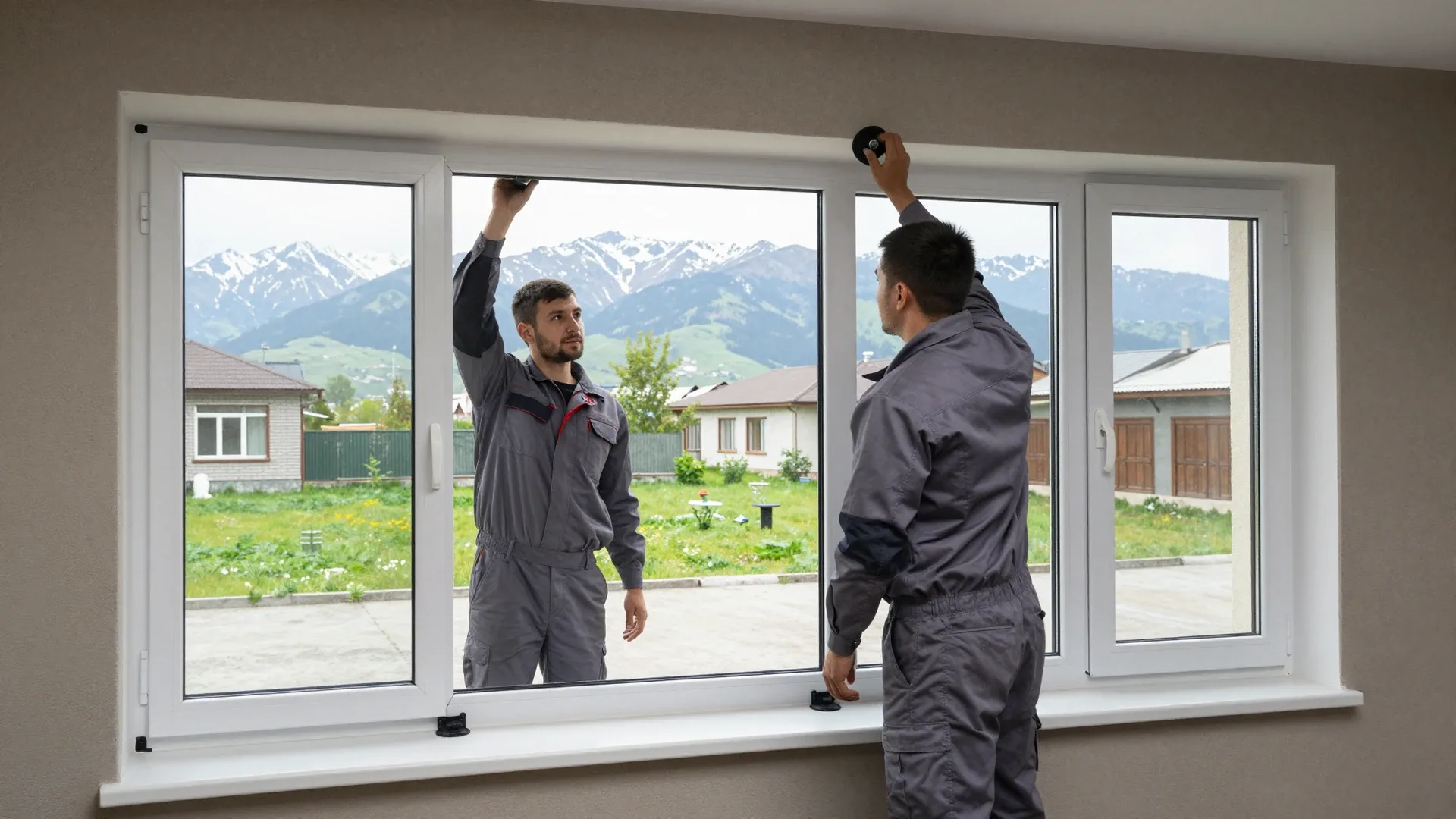
We set the sill, the flashing and the slope finish ourselves on the day of fitting, so nothing is left for you to finish, and the window carries a ten-year warranty with five years on sills, slopes and flashings. One crew removes the old frame, anchors the new one and trims the opening before they leave, and a personal manager stays your single contact from the first call to the final check. Because the same team builds the window in our own workshop and fits it, there is no gap between maker and fitter to argue over if a seal ever needs attention, and the fit is checked against street noise in apartment rooms. Ask for the profile certificates before you sign — we show them at that stage, not after the deposit.
Where to start reducing street clamor
Quiet comes from three components working together rather than from a single expensive upgrade. Below is what to carry into a conversation with any fitter.
- Three paths, single result: traffic rumble arrives through the glazing, the sash seal and the mounting joint, so treating only the first leaves the other two leaking noise.
- Thickness beats chambers for rumble: adding millimetres and a laminated interlayer cuts low traffic frequencies better than a higher chamber count in the profile does.
- Check before you order: a compressed seal and a leaf that no longer pulls tight are the first suspects, and both are fixed by adjustment rather than replacement.
- Swap the glazing, keep the frame: when the profile is sound and the seals hold, a new sealed unit goes into the existing leaf without touching the walls.
- Fitting carries the result: in a nine-point seismic zone a joint that is not packed and sealed properly passes sound straight through, whatever the panes.