Blog · 9 min read
How to choose
window profile

Chambers, width, reinforcement and series compared: what actually affects warmth, quiet and durability, and what to check before you sign.
OKNA PLAST makes PVC windows in its own workshop in Almaty and installs them with its own crews. To choose a window profile, match three things to the room: window profile chambers for warmth, window profile width for the opening and climate, and profile reinforcement for rigidity under local seismic loads. We show certificates before you sign.
How to Choose Window Profile and How Many Chambers It Really Needs
Buyers ask about chamber count first, and it pays to know what that number measures. A chamber is an air pocket inside the sash, and more of them is not automatically better for every room.
What window profile chambers actually do
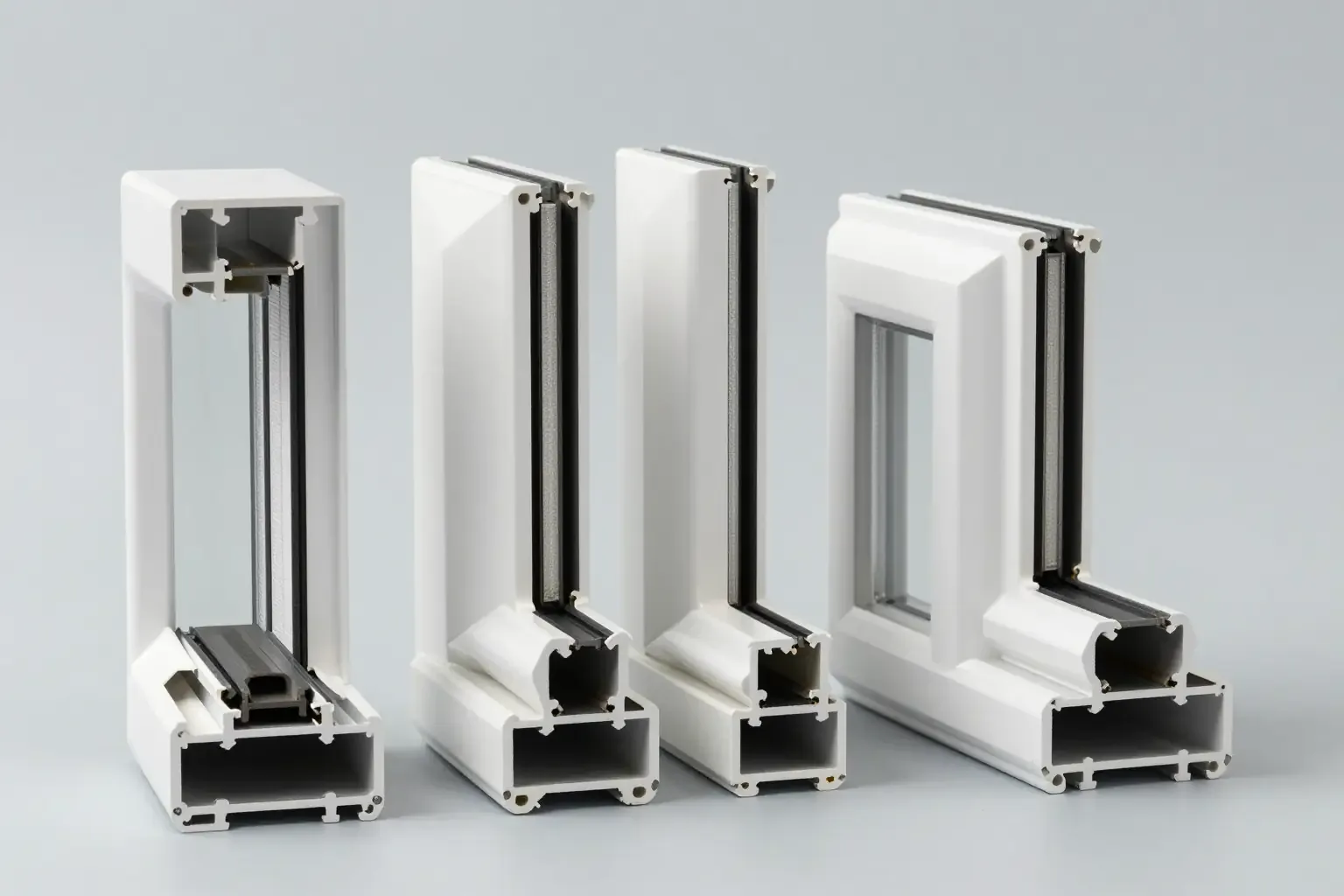
A chamber is a sealed air cavity inside the PVC sash, and each extra one slows heat loss through the profile rather than through the glass. These pockets act as a stack of still-air cavities: SMART carries 4 with a heat-transfer figure of 0.653, Vitra has 4 at 0.770, and WDS premium reaches 5 at 0.970. Every pocket cuts conduction slightly, yet the glass unit and the seam where the profile meets the wall move far more heat than the plastic itself. In most apartments here the plastic is a small share of the opening, so going from 4 to 5 pockets helps less than fixing the glazing or the installation seam. Wall thickness classes, mounting depth and surface quality for PVC profiles are set out in GOST 30673.
Matching chamber count to the room
| Profile series | Chambers | Heat-transfer figure | Frame width |
|---|---|---|---|
| WDS | 3 | 0.878 | 60 mm |
| SMART | 4 | 0.653 | 60 mm |
| Vitra | 4 | 0.770 | 60 mm |
| WDS premium | 5 | 0.970 | 60 mm |
How to Choose Window Profile by Width and What It Changes
Width is the second figure on a profile spec sheet, after the chamber count. It measures how much wall depth the profile occupies — and that figure decides which glass unit it can carry.
What window profile width measures
Window profile width is the mounting depth of the frame, measured from the outer face to the inner face, and it sets the depth of glass unit the frame can hold. A Galwin profile at 60 mm takes a unit up to 30 mm, while the Rehau Geneo at 80 mm accepts one up to 52 mm. The number matters because thermal performance comes from the whole assembly, not the plastic alone: a two-chamber glazing of 32 mm inside a 60 mm profile matches what most local apartments need. A deeper shell only pays off if the glass fills that space — a 70 mm profile with a thin unit performs like a 60 mm one with the same unit, so compare the two figures together, never the depth on its own.
Choosing width for Almaty rooms
For most flats in the city we recommend 70–76 mm frames, because that depth holds a two-chamber unit and still fits standard openings without reworking the reveal. Deceuninck Favorit gives 71 mm, Favorit Space gives 76 mm with six chambers, and Veka Softline 82 goes to 82 mm for houses where the reveal is deep enough. Wider profiles eat into the glass area, so on a small kitchen window a 60 mm one with a good unit can give more daylight than an 82 mm one carrying the same unit. Before signing, ask us to measure the reveal depth — if it is under 70 mm, a deeper frame means trimming the opening, and that changes the installation plan.
Profile Reinforcement and Rigidity
A steel core sits inside the PVC chambers of every window. It holds the shape under wind, glass weight and daily use — and in a seismic region this detail matters more than in a calm climate.
What profile reinforcement does and what thickness is normal
The steel insert inside the PVC chamber keeps the sash straight under wind, glass weight and daily use, and 1.5 mm is the common baseline for residential windows. Deceuninck Favorit and Favorit Space both carry 1.5 mm, so that number alone does not separate one series from another. Wall thickness is the second half of the story: Veka builds its profiles with 3 mm walls and rates service life at up to 60 years, while Salamander bluEvolution uses 3.3 mm walls around six chambers. A thicker shell resists denting and screw pull-out at the hinges, where a sash takes the most load. The two measurements work together; a 3 mm or 3.3 mm shell around a thin metal bar still flexes, so check both numbers, not just one.
Reinforcement and seismic loads in Almaty
We install to GOST with the local nine-point seismic factor in mind, so the metal bar and the fixing pattern are chosen together rather than separately. Our own crews anchor each window at a spacing that matches the wall material — aerated concrete, brick or panel — because the same component behaves differently in each. A rigid frame helps only when it cannot shift in its opening. The steel resists bending, but the anchors resist the horizontal racking a tremor puts on the whole assembly. A stiff frame on weak fixings still racks in a tremor, so ask how the frame is anchored, not only how thick the metal is.
Difference Between Window Profiles and Series
Buyers face a wall of brand names and series codes. What separates window profiles is a handful of measurable numbers, not a logo, and once you know which numbers count, the names stop confusing you.
What actually differs between series
The real difference between window profiles is the combination of chamber count, mounting width, wall thickness and seal contours, and a model name only tells you which combination you get. Rehau Geneo takes a glass unit up to 52 mm and carries three seal contours, while KBE 76 pairs six air pockets with insulation rated to 46 dB. WDS 6S runs five chambers in the sash and seven in the frame, and Salamander bluEvolution reaches 48 dB on 3.3 mm walls. Two products from the same maker can sit far apart on these figures, so compare the spec sheet line by line instead of comparing brands.
Reading a series spec sheet
| Series | Chambers | Mounting width | Wall thickness |
|---|---|---|---|
| Galwin | 4 | 60 mm | — |
| Deceuninck Favorit | 5 | 71 mm | — |
| Deceuninck Favorit Space | 6 | 76 mm | 1.5 mm rebar |
| KBE 76 | 6 | 76 mm | — |
| Salamander bluEvolution | 6 | — | 3.3 mm |
Checking a Profile at the Measurement Visit
The measurement visit is where a profile choice becomes real. Here is what to look at in the sample and what to ask before anyone signs.
Questions to ask the measurer
- Which series and how many chambers: does each room get, and why that count?
- What mounting width: fits this opening without reworking the reveal?
- How thick is the reinforcement: and how is the frame anchored at each fixing point?
- Which glass unit: goes into this depth, and what total thickness does it reach?
- Can I see the profile certificates: before I sign, so the spec is confirmed on paper?
Spotting a weak profile on site
A weak sample shows up as a thin wall, a light frame and a short metal insert, and you can feel the difference when it is handed to you. A solid one has an outer skin you cannot flex between your fingers, a core running the full depth, and two or three sealing contours that meet evenly along the edge. Take Salamander bluEvolution — 6 chambers, 3.3 mm walls — and the weight and stiffness read clearly against a 60 mm four-chamber item. Wall thickness, the count of gaps and the visible inner line tell you more than any brochure photo. Ask to hold a cut piece: a solid skin and a visible core are easier to judge by hand than on a printed page.
Profile, Glass Unit, Noise and Condensation
A profile never works alone. Its chamber count and width only matter in combination with the glazing it carries, and that pairing decides how much street noise stays outside and whether condensation forms on the pane.
Noise from a busy street
Noise reduction comes mostly from the insulated glazing and the seal contours, while the frame sets how thick a pane you can fit and how many seals it carries. A frame with two seal contours and a 32 mm double-glazed pane absorbs far less low-frequency traffic rumble than a 76 mm system with three contours around a 52 mm glazing. Manufacturer data shows the spread clearly: Salamander bluEvolution reaches up to 48 dB, KBE 76 up to 46 dB, and WDS 6S up to 36 dB. Those figures assume matching glazing and correct installation, not the frame alone. A three-contour system with a thick pane cuts street noise better than a deeper profile with thin glazing and one seal, so specify both before picking a series.
Why good windows still fog up
We see condensation on well-built windows when the frame, the glazing and the installation seam are chosen separately, so moisture finds the weakest point. A five-chamber profile with a warm 32 mm pane still fogs along the bottom edge if the mounting seam is thin, the reveal is uninsulated, or the room has no airflow. Our crews install to GOST with seismic loads of 9 points in mind, sealing the seam in layers, and we hand over from contract to installation in no more than two weeks. Before blaming the profile, check ventilation and the seam; a warm frame with a cold edge still fogs, and the fix is often airflow, not a new series.
What to verify in the profile before signing the contract
Choosing a window profile comes down to four measurable things — chambers, mounting width, reinforcement and the sealed glass unit — plus a clear list of questions for the measurement visit.
- Chambers slow heat loss through the sash and outer frame, but the sealed glazing and the perimeter seam usually matter more in an apartment.
- Mounting width sets how deep a glazing unit the profile holds; going deeper without thicker glass gains little.
- Reinforcement keeps the sash straight, and in a seismic region it must be paired with the right anchoring.
- Series names mean little on their own; compare chamber count, profile depth, wall thickness and seals line by line.
- The measurement visit is where the choice is confirmed, so arrive with a short list of questions.