Blog · 9 min read
How to choose
window profile
Author: OKNA PLAST editorial team
- Published
- Updated
A practical guide to chambers, frame width, reinforcement and manufacturer series — so you can compare window profiles on equal terms and avoid paying for features you do not need.
To choose a window profile for a frosty, windy climate, check three numbers: chambers, mounting width and reinforcement. A warm, wind-resistant window usually means 5–6 insulating air gaps, a 70–80 mm frame and a steel insert of at least 1.5 mm. OKNA PLAST builds windows in its own workshop and installs them with its own crews.
How to choose window profile chambers and width for Astana
Long frosty winters and strong winds make chamber count and frame width the two numbers that decide whether a window stays warm and quiet. Here is what each number delivers.
Chambers that actually keep the cold out
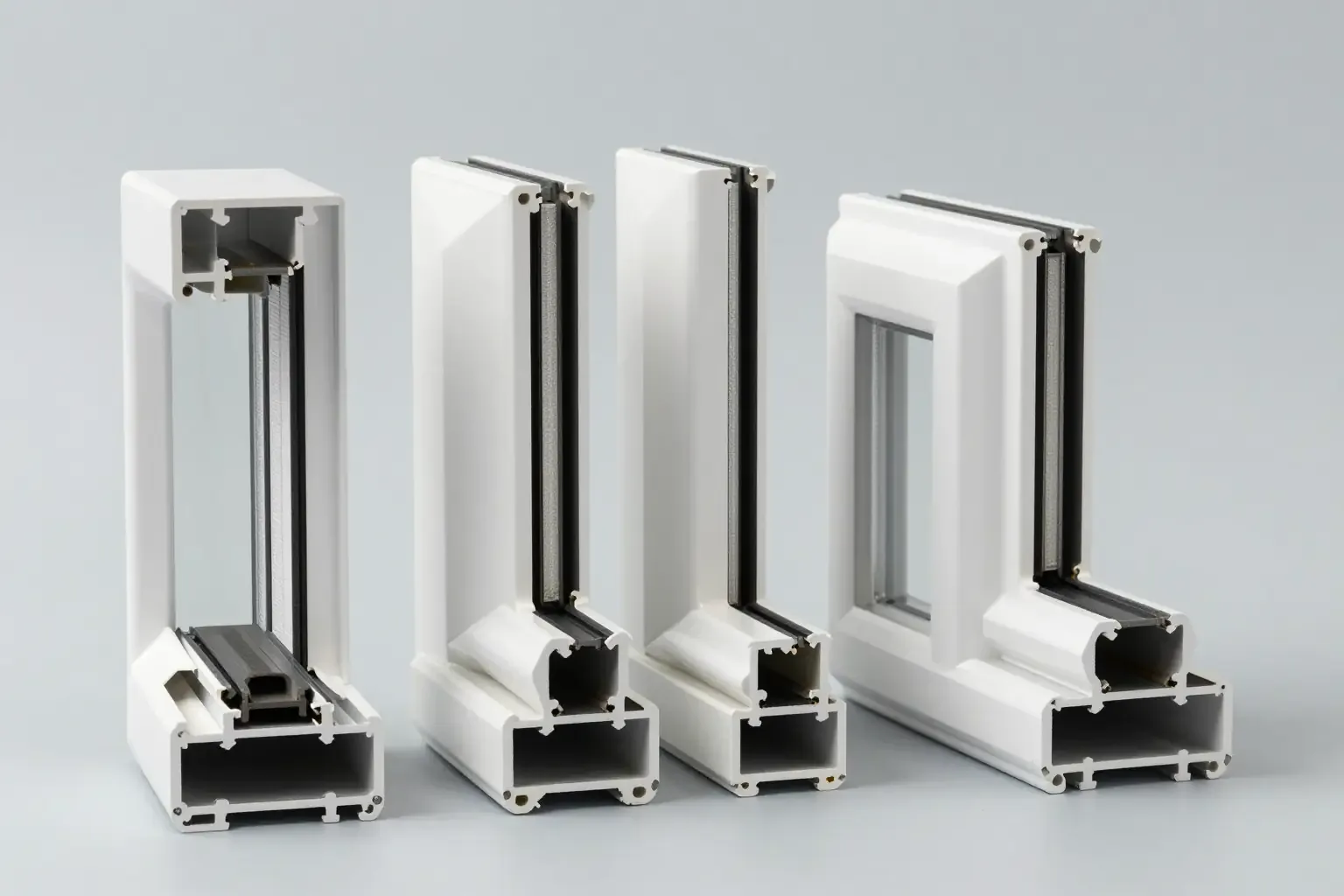
For local winters we recommend profiles with at least 5 chambers, and 6 where the window faces wind or a noisy street. These cavities are trapped air pockets between the outer wall of the frame and the inner one, and every pocket slows heat loss and muffles sound. When comparing window profile chambers, look at how many air pockets sit between the outer and inner walls of the sash. Deceuninck Favorit Space carries 6 at 76 mm, KBE 76 also runs 6 with noise reduction up to 46 dB, and Rehau Geneo adds three sealing contours around its glazing. Budget SMART stops at 4 and suits glazed balconies rather than living rooms. Each extra pocket slows heat loss and adds a sound barrier, but past six the gain is small — money is better spent on the glazing and the warm installation seam.
Profile width 60, 70 or 80 mm and what each gives you
A 60 mm system suits mild rooms and tight openings, while 70–80 mm holds a thicker glass unit and leaves room for a warmer installation seam. The mounting depth of the profile sets how much insulation fits between the sash and the wall. SMART uses a 60 mm depth with a 32 mm two-chamber glazing, Deceuninck Favorit runs 71 mm, and Rehau Intelio 80 reaches 80 mm for deep reveals and exposed facades. Galwin keeps 60 mm with glazing up to 30 mm. A wider profile only pays off if the glazing and the seam match it — an 80 mm system with a thin unit and a cold seam performs no better than a well-built 70 mm window.
Matching chambers and width to the room
| Room / exposure | Chambers | Frame width | Glass unit |
|---|---|---|---|
| Living room, wind-facing | 6 | 76–80 mm | two-chamber, thick |
| Bedroom, quiet side | 5 | 70 mm | two-chamber |
| Kitchen, sheltered | 4–5 | 60–70 mm | two-chamber |
| Balcony block | 5 | 70 mm | two-chamber |
How to choose window profile reinforcement that holds up
Steady wind in Astana loads the sash constantly, and reinforcement — a steel insert inside the PVC chamber — is what keeps the window in shape. Its thickness matters as much as the chamber count.
What profile reinforcement does and why wind makes it critical
Reinforcement is a steel insert inside the PVC chamber that keeps the sash from bending under wind load and holds the hinges and locks in place. A closed steel profile runs through the frame and the sash, so the PVC carries loads together with the metal rather than on its own. On upper floors and open corners the pressure on the sash is highest, and that is exactly where a closed insert does the real work. We mount windows to GOST with the 9-point seismic factor of the region in mind, and a properly reinforced frame is part of that standard. On a wind-exposed upper floor a thin insert lets the sash flex over time, so the window starts to whistle and the hardware loosens — a problem that shows up years after installation.
How thick the steel insert should be
For a wind-loaded window we look for a steel insert around 1.5 mm thick, which is what series like Deceuninck Favorit Space use. Wall thickness of the PVC itself sets the baseline: Veka profiles come with 3 mm walls, Salamander bluEvolution with 3.3 mm, and the two figures work together — a rigid wall plus a solid insert is what resists bending. A thicker insert adds weight and stiffness to the sash, which also keeps the hardware aligned over years of use. Thickness alone is not enough — the insert has to run the full length of the sash and frame, so ask to see a cut sample rather than trusting a spec sheet. Wall thickness classes and surface requirements for PVC profiles are set out in GOST 30673.
Practical guide to selecting window profile series and brands
The difference between window profiles is rarely the logo on the frame. It is what the series was built to do: hold maximum warmth, cut street noise, or deliver a solid warm baseline without over-specifying.
What actually separates one series from another
What really separates the series is which problem each one solves best — Rehau Geneo and Intelio 80 for maximum warmth, KBE 76 and Salamander bluEvolution for noise, SMART and Vitra for a warm budget option. Rehau Geneo takes a glass unit up to 52 mm and carries three seal contours, so the frame and the glass work as one thermal barrier. KBE 76 holds sound down to 46 dB, while Salamander bluEvolution reaches 48 dB on 3.3 mm walls. In our practice a top series on a sheltered kitchen wall buys warmth you simply will not feel. Pick the series by the room's job, not by brand fame.
Series matched to warmth, noise and wind
| Task | Series to look at | Key numbers |
|---|---|---|
| Maximum warmth | Rehau Geneo, Intelio 80 | glass unit up to 52 mm, 3 seals |
| Noise from the street | KBE 76, Salamander bluEvolution | up to 46–48 dB |
| Warm budget option | SMART, Vitra | 4 air gaps, 60 mm frame |
| Entrance door | reinforced door profile | 3.2 mm steel |
Profile, glass unit and installation as one system
A warm window is not one lucky profile but a chain of three links: the sash, the glass unit and the seam where it all meets the wall. The weakest link cancels the other two.
What matters more, the profile or the glass unit
The glazing carries most of the heat loss, so a good two-chamber glazing in a 70 mm frame beats a thick profile with a thin pane. The glazing covers most of the window area, and that is where the cold and the noise come through first. The outer casing sets the limit: our SMART profiles take a 60 mm system with a 32 mm two-chamber unit, Galwin holds up to 30 mm, and a Rehau Geneo profile accepts a pack up to 52 mm with three sealing contours. You cannot push a 52 mm glazing pack into a 60 mm system — the rebate simply will not close. The window profile width and the glass unit have to fit each other, so the two are chosen together, not one after the other.
Why the installation seam decides whether the window is warm
A warm installation seam and warm slopes are what stop the cold from coming in around the opening, so even a top profile leaks heat if the seam is done cold. In a city with long frosty winters and strong wind, the joint between the casing and the wall takes the load that no chamber count can absorb. We build that seam to GOST with seismic loads of 9 points in mind, and we fit the sill, the flashing and the slope finish ourselves on the same day, so nothing is left open overnight. Condensation on the pane in winter is often a seam or slope problem, not a profile one — check the seam before blaming the window.
What to ask the surveyor about the profile
The survey is where the profile is finally settled, and a few precise questions stop you paying for depth you do not need. Ask the surveyor to justify every number against your room.
Questions that keep you from overpaying for chambers
- Which series fits this room and why: ask for the reasoning, not just a brand name — the answer should reference your exposure.
- Number of chambers and width: confirm the figures suit the glass unit, since a deep frame with a thin pane wastes depth.
- Thickness of the profile reinforcement: request a cut sample so you can see the steel insert and measure it.
- What glass unit goes with this frame: the two are chosen together, and a two-chamber pane in a shallow frame underperforms.
- What the installation seam includes: warm seam and warm slopes, not just the sash.
How we confirm the profile before you sign
We show the profile certificates before the contract is signed, so you can check the chambers, width and reinforcement against the manufacturer's data. Each certificate lists the series, wall thickness and reinforcement spec, and we set it beside a cut sample from our own workshop so the document and the physical profile are compared side by side. The same paperwork travels with your order, and your personal manager answers questions on it while the survey is still fresh. Seeing the certificate and a cut sample together is the fastest way to confirm a spec sheet matches the real product — and it is the reliable route to choosing a window profile without trusting a brochure alone.
How to check a profile before ordering windows
A window profile comes down to three numbers and one principle: chambers, mounting depth, steel thickness — and the fact that all the parts perform as a single whole.
- Start with the core specs: 5–6 air cavities in a 70–80 mm frame handle a frosty, windy climate, while 3–4 in a 60 mm one suit milder rooms.
- Reinforcement is not optional: an insert around 1.5 mm keeps the sash rigid under wind load, so never accept a profile without it.
- Match the series to the room: warmth, noise and budget each point to a different line, from entry-level 60 mm options to 80 mm ones.
- Judge the whole, not the part: the extrusion, glass unit and warm seam work together, and the weakest link decides the final result.
- Ask before you sign: every parameter — cavity count, mounting depth, metal thickness and certificates — should be explained and shown to you in writing.