
Blog · 9 min read
Why plastic windows
fog up

A practical guide to condensation on window glass: what is normal, what points to a failed seal, and when it is worth calling a specialist to your home.
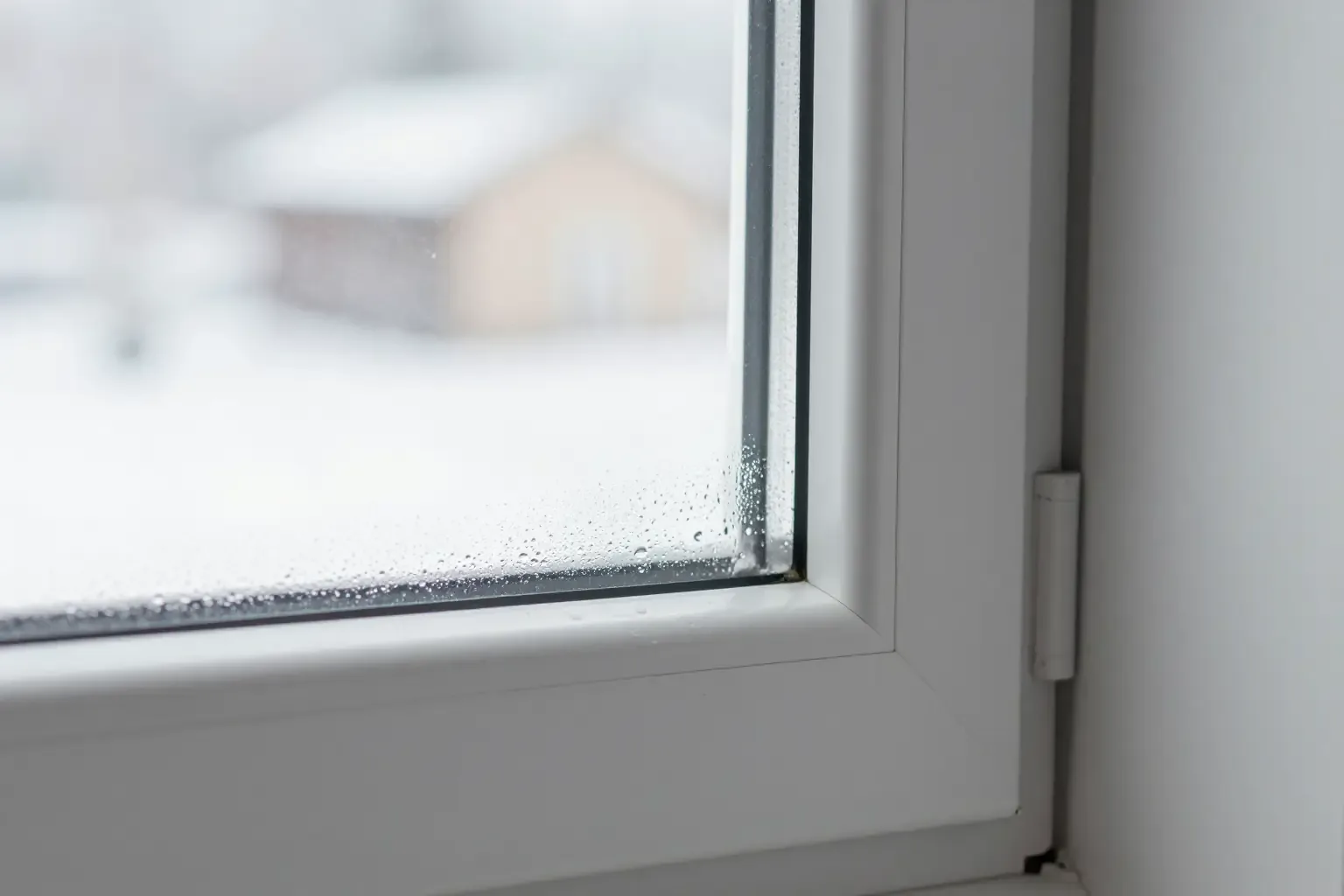
OKNA PLAST makes plastic windows in its own workshop and installs them with its own crews across Almaty, so we see condensation from both sides of the frame. Fogging is usually warm indoor air meeting the coldest surface of the window. It becomes a real problem when water sits between the panes or mold appears on the slopes.
Why plastic windows fog up and where the moisture comes from
Condensation is physics, not a defect by default: warm, moist air meets the coldest surface, almost always the glass. If your windows crying what to do first is find that cold surface.
The dew point explained in plain numbers
Condensation begins when indoor air cools to its dew point, which for a normal room at around 20 °C arrives near 50–60 % relative humidity. At that temperature the air holds roughly 17 g of water vapour per cubic metre; drop the surface a few degrees and it can no longer keep it all, so the excess settles as droplets. A double-glazed unit with a 32 mm cavity keeps its inner pane within a couple of degrees of the interior, while a single cold pane in an older frame falls far enough to fog at much lower humidity. The glass is always the coldest plane indoors, so it fogs first even when walls and furniture stay dry. Indoor temperature and relative humidity limits for cold and warm seasons are set out in GOST 30494.
Where the water in your flat actually comes from
- Cooking: a simmering pot for half an hour sends a steady plume of steam through the flat.
- Showering: a ten-minute hot shower loads the bathroom with vapour that escapes once the door opens.
- Drying laundry: a full indoor rack releases litres of water over a day.
- Breathing: each sleeping adult adds about half a litre of vapour overnight, multiplied by the household.
- Plants and aquariums: open water and damp soil keep feeding humidity around the clock.
Why one room fogs and the next stays dry
A single foggy window usually points to a local imbalance — a closed vent, a blocked air path or a colder orientation — and we check these before blaming the unit. Spaces with the least circulation and the most moisture, typically kitchens and bedrooms with closed doors, reach the dew point first even when the glazing is identical across the flat. On surveys across Almaty our engineers measure humidity room by room, and the dry spaces almost always turn out to have an open trickle vent or a door left ajar. Before a quote we visit, measure and trace where the moisture builds up, so the fix matches the cause rather than the symptom.
Reading the side of the glass inside, outside or between panes
The side of the glass where water appears narrows the cause: inside points to humidity and airflow, outside is often normal, and between panes flags the sealed unit.
A quick table for reading the side of the condensation
| Where the water sits | What it usually means | What to check first |
|---|---|---|
| Inner pane, room side | High indoor humidity or weak ventilation | Air flow and daily airing |
| Outer pane, street side | Normal cold-morning effect on insulated glass | Nothing, it clears itself |
| Between the panes | Sealed unit has lost its seal | Glazing unit replacement |
| Bottom edge and frame | Cold bridge or worn seal | Seal and hardware setting |
Condensation or a leak, how to tell them apart
Condensation shows up as an even film or droplets that wipe away and return with the weather, while a leak leaves streaks, staining or water running down the frame after rain. With condensation on double glazing, the film sits across the whole pane and disappears once the room warms and air moves. A leak follows a line — along the mounting seam, under the sill, or from the drainage channel at the bottom of the frame. We fit the sill, the flashing and the slope finishing ourselves on installation day, so the joint between window and wall is one our own crews close and can inspect. If water tracks down the frame after rain rather than on a cold morning, the mounting seam and the sill line are checked first.
Winter fogging and what the seasonal hardware setting changes
In winter the gap between a warm flat and the street widens, so glass cools harder nightly. Here is what the seasonal setting changes and when ventilation alone suffices.
Why moisture on windows in winter is a seasonal pattern
This fogging appears because outdoor temperature drops faster than indoor humidity, pushing the glass below the dew point every night. In Almaty the cold season brings nights well under freezing while a lived-in flat releases vapour from cooking, showers and drying laundry. A double-glazed unit with a warm side and a −10 °C street side can see its inner pane fall to 8–10 °C, and indoor air at 50% humidity condenses at roughly 9 °C. Only the balance between surface temperature and vapour content changed. The same home that stays dry in summer fogs in January with no change to the glazing, so the cure is ventilation and moisture control, not new panes.
What the winter hardware setting does and does not fix
- What it fixes: eccentric cams pull the sash tighter onto the seal, closing gaps that whistle on windy nights.
- Where it helps: the perimeter and hinge side, where a loose seal chills the unit edge.
- What it does not fix: a pane already below the dew point; no seal warms the glass centre.
- The trap: a fully tightened sash cuts the drying trickle, so fogging moves to the slopes.
- Our approach: we set hardware for winter and pair it with a slot ventilator or supply valve.
Airflow fixes that cost nothing
- Cross-ventilation: open two opposite windows for 5–10 minutes twice daily to swap the whole volume.
- Tilted versus wide open: a window tilted all day cools the reveal, where mold starts.
- Supply valve: a wall or sash valve feeds 5–30 m³ of fresh air hourly without dropping indoor temperature.
- Extractor in the wet rooms: run the kitchen hood and bathroom fan while cooking and showering.
- Hygrometer check: keep the flat at 40–50% relative humidity and air rooms before glass weeps.
When the cause sits in the profile, the glazing unit or the installation
When indoor humidity is normal and glass still runs wet, the cause moves into the frame, glazing unit or mounting seam, and each parameter shifts the risk.
How chambers and glazing thickness change the fogging risk
| Window parameter | What it changes for condensation | Example from our range |
|---|---|---|
| Number of chambers | Warmer inner surface of the frame | Deceuninck Favorit Space, 6 chambers |
| Mounting width | More room for insulation | Deceuninck Favorit Space, 76 mm |
| Glazing thickness | Warmer inner pane | Geneo, up to 52 mm |
| Seal contours | Fewer draughts at the edge | Geneo, 3 seal contours |
Installation quality and the GOST standard with seismic margin
A mounting seam that is insulated and sealed to GOST keeps the frame edge warm, while a cold bridge there pulls the dew point onto the glass within the first cold week. Most post-install fogging starts in this joint: foam compressed unevenly, a gap under the sill or a vapour barrier taped in the wrong order lets cold air reach the frame, and the inner edge drops several degrees below room temperature. We install to GOST with a nine-point seismic margin, so the joint stays tight through the temperature swings the city sees between seasons, and our own crews handle the whole turnkey job. Ask for the joint detail in the contract before signing — it matters more for condensation than the profile series you pick.
New windows that fog more than the old ones
New windows are far tighter than old timber frames, so they trap indoor moisture that used to escape through gaps, and the first winter often shows more fog until ventilation catches up. This is a ventilation adjustment, not a defect, and our crews walk the client through airing and the hardware setting right after the turnkey install. We fit windows with our own teams and finish the sills, slopes and flashings the same day, so the airflow advice comes from the people who closed the joint. Give it two to three weeks of regular airing before you treat it as a fault.
Mold on window slopes and what it tells you about the whole assembly
Mold on window slopes is almost always a consequence, not a cause. It appears while the glass looks dry, and the finishing layer around the reveal changes the risk.
Why mold on window slopes appears even when the glass is dry
Mold grows where the surface stays cold and damp, which can happen at the slope even when the glass looks dry. This band sits at the junction of the frame, the wall and the insulation, so its surface runs two to four degrees below the room air on a cold night. Water vapour from cooking and drying laundry settles on that colder strip first, and the plaster holds the film instead of letting it run off. A mounting seam foamed but never taped lets humid air reach the plaster from behind. That corner is often the coldest part of the reveal, so damp gathers there and feeds spores before any droplet shows.
How turnkey finishing and a five-year warranty reduce the risk
- Sill, flashing and trim in one visit: one team closes the reveal when the frame goes in, so no seam waits.
- Sealed mounting seam: vapour-tight taping keeps humid air off the plaster behind the trim.
- Ten-year cover on the unit: profile, glazing and hardware we install are included.
- Five-year cover on the finish: sills, trims and flashings, where spores start, are backed for five years.
- One contact for the whole period: a personal manager handles any call on the surround.
When condensation stops being a minor issue
Fogging on plastic windows is one of those problems where a handful of checks tell you most of the story before any work begins.
- Physics first: warm, humid indoor air meets the chilliest surface, so measure humidity before blaming the window.
- Read the surface: water inside points to ventilation, outside is often normal, between panes means a failed seal.
- Winter is a pattern: fogging follows temperature drop; hardware setting helps the frame edge but cannot warm a chilled pane.
- Check the assembly: when humidity is normal and glass still mists, look at chambers, glazing thickness and mounting seam.
- Watch the slopes: mold grows in a damp, poorly finished reveal, so proper finishing matters as much as the unit.