
Blog · 10 min read
Why plastic windows
fog up
Author: OKNA PLAST editorial team
- Published
- Updated
Understand what causes condensation on glass, when it is normal and when it points to a fault. Learn how to check your windows and what to fix first.
Why plastic windows fog up: warm, moist indoor air meets cold glass and drops below the dew point. Long frosty winters and strong wind speed this up, especially on single-chamber units and cold slopes. OKNA PLAST builds windows in its own workshop and installs them with a warm seam, so the frame stays warmer and condensation is less likely.
Where the moisture actually appears when plastic windows fog up
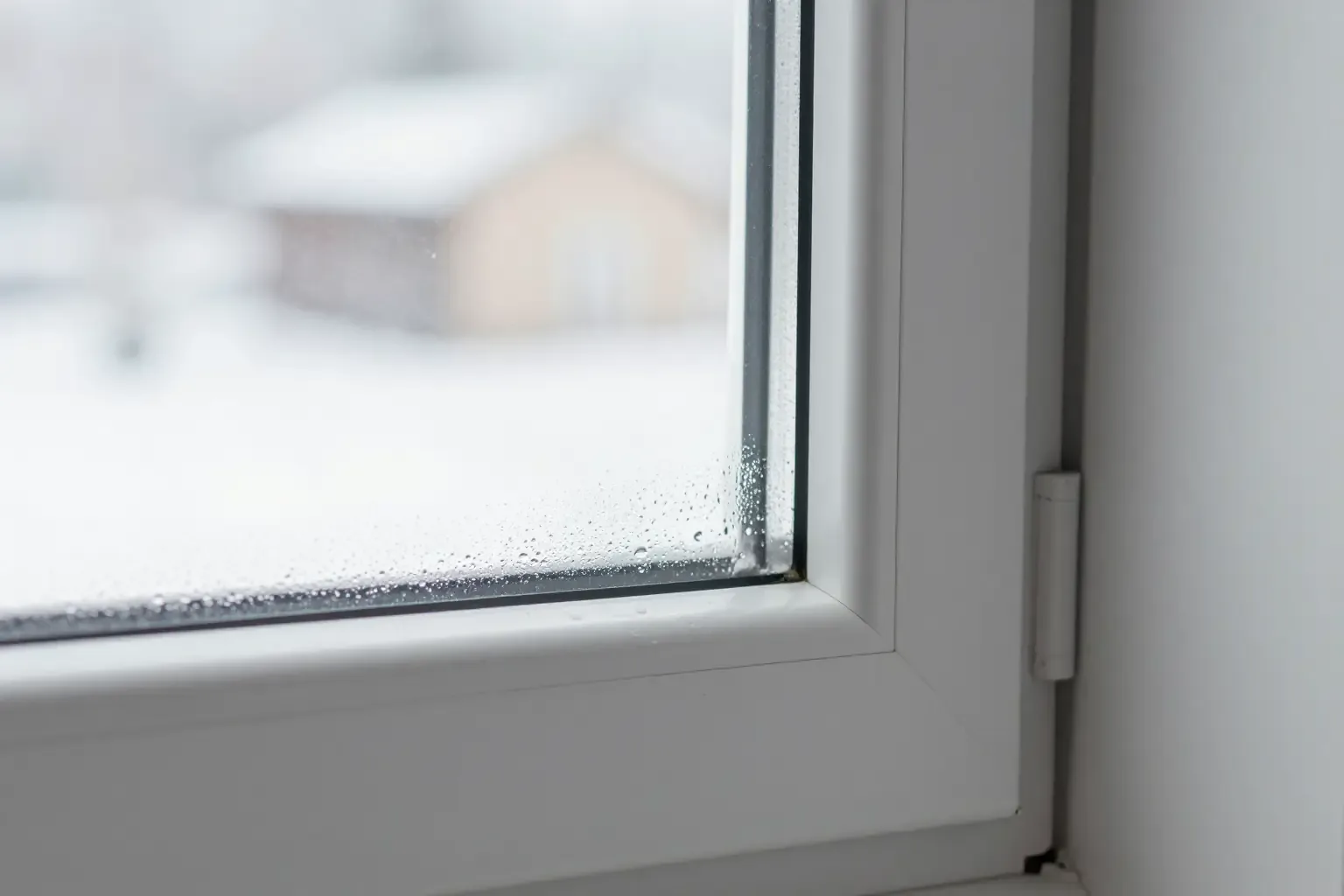
Before you blame the window, find out where the water sits. To understand why plastic windows fog up, first separate the three surfaces where it happens. Outside, inside and between the panes are three different stories with three different answers.
Outside, inside or between the panes
Condensation on the outdoor surface is normal physics, damp on the room side is household moisture, and fog between the panes means the sealed cavity has lost its gas fill. A double-glazed unit 32 mm thick holds two air chambers, and its outer sheet chills first when the street drops below the indoor dew point, so beads facing the weather are expected and harmless. Wetness on the room-side surface points the other way — at cooking steam, drying laundry and weak extract, not at the frame. Mist trapped inside the cavity is a different category: the perimeter seal has failed, argon has escaped and the desiccant is saturated. If that haze never clears, no amount of ventilation will help — the sealed unit itself must be replaced, and that is a workshop job, not a wipe-down.
Telling condensation from a leak
Condensation is clear, spreads evenly over the glass and dries when you air the room, while a leak leaves streaks, runs down from one spot and stains the frame or sill. Real seepage usually starts at the junction of frame, slope and sill — the warm installation seam that keeps the perimeter from freezing in a windy winter. Fresh moisture there carries dust, leaves a grey tide mark on the plaster and reappears after rain or a thaw, not after a shower. Sweating glazing behaves the opposite way: the film is uniform, the drops are round and the whole surface clears soon after you open a vent. Wipe the bottom of the glass with a dry cloth and check the sill joint the next morning — if the damp patch returns in the same corner, the liquid is coming through the seam.
Causes of condensation on window glass during cold weather
Winter condensation is not a defect by itself. It is a balance between how much vapour the air holds and how cold the inner pane gets.
The dew point in plain terms
The dew point is the temperature at which air can no longer hold its vapour, and at a normal indoor humidity of around 40–50 % it sits close to the inner pane on a frosty day. A living room kept at 21 °C with 45 % relative humidity has a dew point near 8–9 °C; the edge beside the frame in a hard frost runs colder than that, so water appears there first. Cooking, showering, drying laundry and dozens of plants push the same room to 60–70 % within an hour, and the dew point climbs with it. The window is simply the coldest surface the air touches. A cheap hygrometer left on the sill for a week tells you more than any guess — if it reads above 60 % in winter, the vapour load, not the glazing, is what to fix.
Why Astana winters hit harder
We build for the local climate because the long frosty season and strong wind cool the frame and the slopes faster than in milder regions, so the same indoor humidity condenses sooner. Wind does not just feel cold — it pulls heat out of the perimeter, so a thin seam or a cold slope shows water first even when the centre of the glass stays clear. That is why our specification for the city leans on a multi-chamber profile and a two-chamber 32 mm glass unit, with warm slopes and a properly insulated mounting seam around the opening. In our practice the perimeter, not the middle of the pane, is where frost and moisture on windows in winter show up first. When you compare quotes, ask what happens at the junction of frame, seam and slope — that detail decides whether the surface stays dry in a hard frost.
When the fault is in the window or the installation
Sometimes the glass itself is fine and the problem sits around it — in the profile, in the glass unit, or in the way the frame was set into the wall.
Profile, glass unit or the seam around them
We check three things in order — chambers in the profile, the glass unit, and the warm seam — because a single-chamber pane or a cold seam fogs up long before a properly built window does. In our practice the profile usually carries 4 to 6 chambers, and Deceuninck Favorit Space gives 6 chambers at 76 mm with 1.5 mm steel reinforcement. A two-chamber 32 mm unit keeps the inner pane warmer than a single-chamber one, so the surface stays above the dew point for longer at the same room humidity. That is why condensation on double glazing is far rarer than on a single-chamber pane. The seam matters just as much: a standard foam joint lets the frame edge run cold, and that cold edge is where beads of water appear first.
What we compare before choosing parts
| What we check | Weak option | Strong option for Astana |
|---|---|---|
| Profile chambers | 3–4 chambers, 60 mm | 5–6 chambers, 70–76 mm |
| Glass unit | Single-chamber | Double-chamber 32 mm |
| Seam | Standard foam | Warm seam, GOST with 9-point seismic |
| Slopes | Cold finish | Warm slopes, 5-year warranty |
New build, new windows, first winter
We see fresh-build flats fog up in the first heating season because the walls and screed are still drying out and release a lot of moisture into the air. The same happens right after installation: a new window is airtight, so the vapour from plaster and concrete has nowhere to escape and settles on the coldest surface — the pane. Our fitters mount to GOST with the 9-point seismic factor in mind, and we hand over the finished window with slopes and sill in place from contract to installation within two weeks. In a new flat, run the ventilation and air the rooms daily for the first months — the window is usually fine, and the extra moisture drops once the building dries.
What you can fix yourself before calling anyone
Most morning water is a habit problem, not a glazing fault. If you are wondering windows crying what to do, start with habits before calling anyone. A few simple steps settle it before you need anyone on site.
Air, heat and the winter setting
We tell customers to air rooms briefly and often, keep the heating steady and switch the hardware to its winter setting so the sash presses tighter against the seal. The winter mode tightens the sash against the gasket and adds real pressure instead of masking the symptom. Keep radiators unobstructed and let warm air reach the pane rather than trapping it behind a curtain. Short bursts of full ventilation clear the moisture faster than a sash left tilted all day, which only cools the frame and makes the pane sweat more. In our practice, short frequent airings beat one long draft every time — and if the leaf still will not pull tight, the hardware needs adjusting rather than more force on the handle. Indoor temperature and relative humidity limits for dwellings are set out in GOST 30494.
Why one window fogs and another does not
The kitchen and bathroom units fog first because cooking, showers and drying laundry push local humidity far above the rest of the flat. A bedroom unit with the door open to a warm hallway stays clear, while the same glazing behind a closed door collects water by morning. Ventilation lowers that local moisture at the glass directly, so the two rooms where steam is generated need the strongest air path out. A cooker hood that vents outside and a closed bathroom door do more for those two rooms than any adjustment to the sash. If the pane stays wet after both are in place, the problem is upstream — in the glass unit or the seam.
Mold on slopes and the point where you need service
Some signs mean the window needs a professional look, not another wipe. Here is where self-help stops and service begins.
Red flags that mean call a fitter
We ask you to call when mist sits between the panes, water runs down the whole frame or dark spots appear on the slopes, because each of these points to a fault the glazing cannot fix on its own. Sealed mist means the cavity has lost its desiccant and no wiping reaches it. Water tracking the full perimeter usually traces to a failed mastic bead or an uninsulated reveal, and hard frost with strong wind exposes that gap fast. Mold on window slopes is the clearest signal, since it only grows where a surface stays cold and damp for weeks. Black spots are a moisture trail, not a stain — cleaning them without fixing the cold bridge behind brings the growth back.
What service covers and what warranty applies
We keep a 10-year guarantee on windows and a 5-year one on sills, slopes and flashings, and our service covers adjustment, seal and handle replacement and glass unit swaps. The full list runs to 13 services, from re-tensioning the sash hardware to replacing a failed double glazing unit, and a personal manager tracks each request from the first message to the finished visit. Hardware and handles carry their own cover, so a stiff handle is a service item rather than a new window. A fogged cavity and a cold reveal fall under different terms, so note which part is failing before the fitter arrives. Send a photo of the misted pane and the edge in one frame — that shot tells us which term applies.
How to tell normal fogging from a defect
Fogged glass is a symptom, not a diagnosis. The location of the water and the season narrow down the cause faster than any single observation taken alone.
- Where the water sits: beads on the room side point to humidity and ventilation, while mist sealed between the panes means the sealed cavity has failed.
- Winter balance: indoor moisture and surface temperature decide whether vapour condenses, so a colder frame edge fogs sooner than the centre.
- Build of the pane: a single-chamber assembly cools its inner surface faster than a two-chamber one, so the same space can fog on one window and stay clear on another.
- Everyday fixes: airing the interior briefly and switching fittings to the winter setting clear most morning film without any parts being touched.
- Call a fitter: fog trapped inside the assembly or mold spreading across the slopes will not dry out with ventilation and needs a professional look.