
Blog · 9 min read
Plastic window
care
Author: OKNA PLAST editorial team
- Published
- Updated
A practical guide to cleaning, lubricating and checking PVC windows so seals stay soft, hardware moves freely and glass stays clear in Astana's climate.
Plastic window care in Astana means washing PVC with mild, ammonia-free products, keeping the seals soft and the hardware greased, and clearing drainage slots before the frosts. OKNA PLAST builds windows in its own workshop and services them after installation, so the same team that installs your windows can regulate sashes, replace seals and swap handles.
What to wash plastic windows with for safe care of frames and seals
PVC and glass need different cleaners; the wrong one leaves a chalky film or dries the seal. Here is what works and what shortens window life.
Safe products for the profile, the glass and the seals
Safe products for the profile, the glass and the seals. For everyday plastic window care, use a mild soap solution or a dedicated PVC cleaner with a soft sponge or microfiber cloth, then wipe dry. On the frame, use a pH-neutral product without solvents, because the seals contact whatever runs down the profile. Microfiber holds dirt instead of pushing it into the surface texture; a second dry cloth lifts residue before it dries. Ammonia glass spray is fine on the pane but not on the seal — ammonia dries the rubber, so keep cloths and bottles separate. On our installations, seals age first, mostly from cleaning habits, not climate.
What damages PVC and when a pressure washer is too much
- Abrasive powders and scouring pads: leave a matte grey patch no polish restores.
- Acetone, white spirit and paint thinners: soften PVC and strip its protective layer within a few applications.
- Melamine sponges: act like fine sandpaper and dull the frame with every wipe.
- A high-pressure washer: drives water past the seal into the drainage chamber faster than it drains.
- Metal-edged squeegees and hard brushes: scratch the sill line where grit gets trapped.
Cleaning double glazing without streaks or trapped moisture
A sealed unit is washed from the room side with the same mild solution, top to bottom, finishing with a squeegee or dry microfiber. We wash the outer pane the same way from outside, never through an open sash where the frame can flex. A two-chamber unit stays clearer than a single-chamber one, as the extra air gap keeps the inner pane warmer and condensation forms later. The spacer bar and sealant edge need only a damp cloth — solvent softens the secondary seal. Mist between the panes is not a cleaning problem: the unit has lost its barrier, and no cloth will reach it.
Caring for plastic window seals and hardware through the year
Rubber and metal age differently and fail quietly. A short calendar of seal maintenance and hardware lubrication keeps the sash pressing evenly and wind outside.
How often to grease the hardware and soften the seals
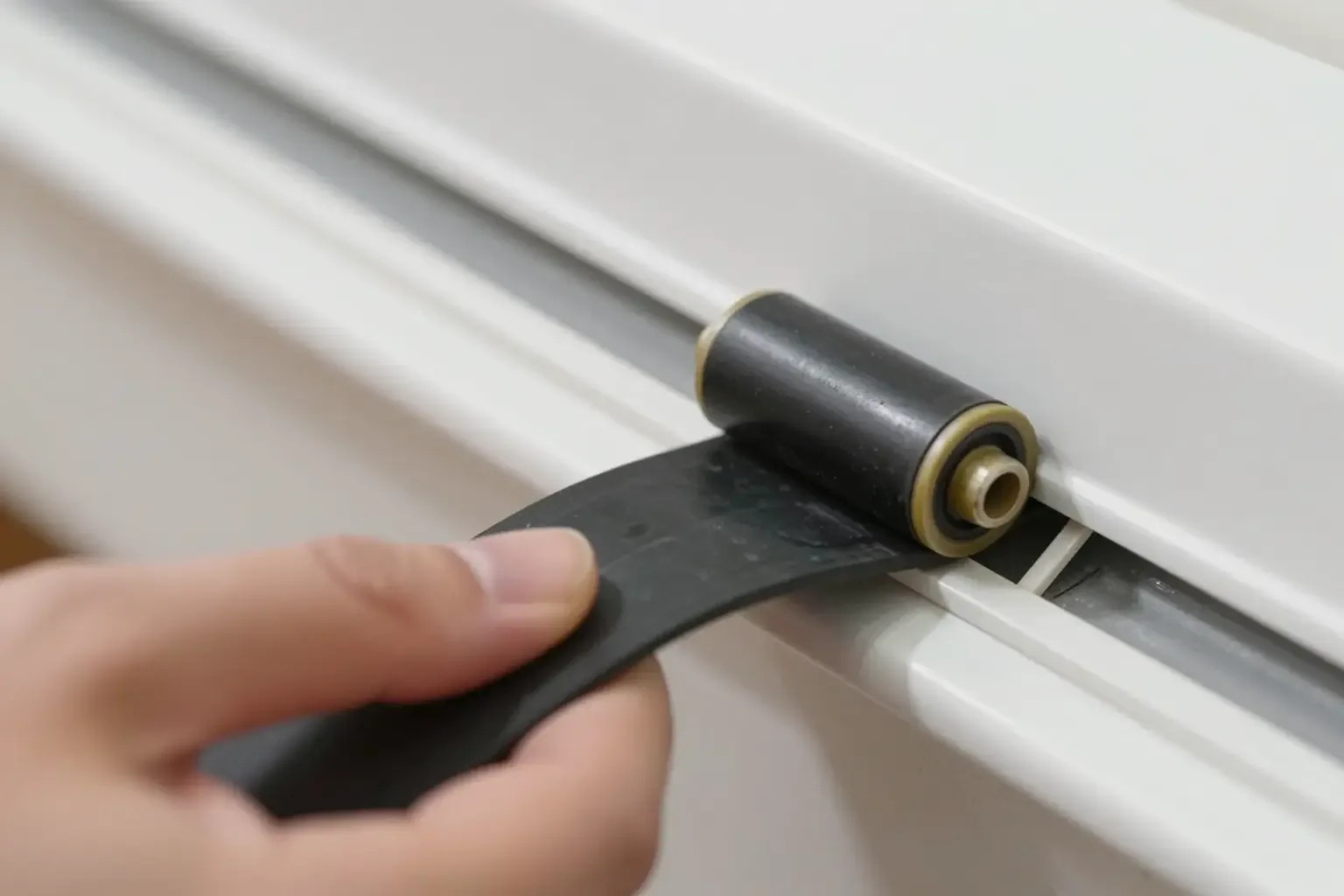
Grease moving hardware twice a year and treat seals with silicone at the same visits, ideally before winter and after it. On hinges, locking points and mushroom cams, load-bearing surfaces take a thin film rather than a thick layer that collects dust. Wipe seals with a damp cloth first, then run a silicone stick along the contour so the gasket stays soft through frost season. A handle needing a firmer push means the pull has drifted. Grease hinges and locking points, not the visible handle spindle alone — parts that seize are the ones you never see until the leaf stops closing flush. Lubrication and rubber treatment steps are detailed in the MACO user guide.
A simple care calendar by component
| Component | What to do | How often | Warning sign |
|---|---|---|---|
| Seals | Wipe, apply silicone | Twice a year | Cracks, hard gasket |
| Hardware | Grease hinges and locking points | Twice a year | Stiff handle, poor pull |
| Drainage slots | Clear with a thin brush | Before winter | Water on the sill |
| Glass unit | Wash inside and out | As needed | Mist between panes |
| Frame surface | Mild soap, dry cloth | Monthly | Chalky film, yellowing |
When a seal is past saving and needs replacing
- Hard gasket: a contour that no longer springs back after a fingernail press has lost elasticity.
- Visible cracks: splits at corners and along the hinge side let cold air past the leaf.
- Flattened profile: rubber pressed thin over years leaves a gap you feel at the edge.
- Paper test: shut a sheet in the leaf and pull — no drag means grip is gone.
- Replacement: our team swaps seals, handles and glass units; hardware carries a warranty.
- Timing: book the contour change before cold sets in; a worn seal costs more heat than it saves.
Condensation, winter mode and plastic window care before an Astana winter
Long frosts and strong wind load a window more than any season. Most winter complaints stem from moisture and pressure, both manageable before cold arrives.
Why condensation forms and what it is telling you
- Room-side mist: warm moist air meets a cold inner pane and condenses on the coldest surface.
- Humidity first: cooking, laundry and showering push moisture into the air until it settles on glass.
- Ventilation second: short full-airing bursts three to four times daily replace damp air faster than a leaf ajar.
- Two-chamber glazing: a double unit keeps the inner pane warmer, so moisture condenses less.
- Multi-chamber profile: five or six chambers slow heat loss at the edges, where mist appears first.
- Between the panes: mist inside means the seal failed; no wiping will clear it.
Winter mode and the pre-season checklist
- Sash pressure: check locking points pull the leaf evenly; a summer setting leaks warmth in wind.
- Winter mode: turn locking cams slightly so the leaf presses tighter; treat as seasonal, not permanent.
- Drainage slots: clear slots under the leaf so meltwater drains instead of freezing in the profile.
- Gaskets: feel each one; it should be soft and springy, as hard strips stop closing the gap.
- Warm installation seam: foam and vapour barrier protect against frost and keep the reveal dry.
How the build of the window shapes the care it needs
A six-chamber profile with a wide glazing unit holds warmth better and shows less condensation, so it asks for the same routine but forgives more. Rehau Geneo carries a glazing unit up to 52 mm and three seal contours, Deceuninck Favorit Space gives six chambers at 76 mm with 1.5 mm steel reinforcement, and Salamander bluEvolution pairs six chambers with 3.3 mm walls. Each handles the local winter with margin, and the difference shows in how often the inner pane mists. More seal contours mean more places to wipe and grease, so it helps to know what to wash plastic windows with before the frost sets in.
Drainage and ventilation, where the moisture actually goes
Drainage and ventilation — water entering the frame has one legal way out, not the seal; understanding this path explains most damp patches owners blame on the glass.
How drainage slots work and how to keep them open
Drainage slots sit in the bottom of the frame and let water run outside, and they clog with dust and leaves faster than most owners expect. Each sash carries two to four narrow channels cut through the outer wall of the profile, with a hinged cover flap that opens under the weight of liquid and closes again to block wind. Meltwater and rain collect in the lower chamber, travel sideways along a slight slope and exit through those channels onto the sill and the drip edge. In a windy city the same slots also swallow fine dust, and a blocked channel pushes moisture back into the profile. Clear them with a thin brush or a bent paper clip from the outside, not by poking a screwdriver through from the room — the cover flap bends and stops shedding liquid.
Ventilation habits that keep the frame dry
- Burst airing: open the sash wide for five to ten minutes two or three times daily, not tilted for hours.
- Cross flow: open a second window opposite so air changes rather than circling.
- Tilt only as a pause: use tilt briefly in cold weather, never all season.
- Clear the path: keep furniture and curtains a hand's width from the sill.
- Watch the hygrometer: above 50 percent in winter means air more often, not add heat.
A sash that no longer closes and the point where you call the service
Some faults are a five-minute adjustment, others a worn part no care will fix; telling them apart saves a call or a draughty season.
What you can fix yourself and what you should not touch
A stiff handle or a sash rubbing at the top is usually a matter of adjustment, while a cracked seal or mist inside the glass is a part replacement. A dry spindle needs grease, a loose screw tightening, and a top-corner rub goes away once the hinge pin is turned a millimetre or two. Draught along the edge is often just pressure set too low — turn the eccentrics a quarter step until the rubber touches evenly. Flattened rubber that lost its spring, or a unit misted inside, cannot be cleaned back to life. Forcing a misaligned leaf shut bends the locking points, so stop at the first resistance.
Symptoms that mean it is time for the service team
We send the service team when the leaf drops, the seal cracks, the handle works loose or the glass unit mists inside — these are part swaps, not cleaning. A dropped leaf shows as a gap at the top corner and a scrape mark on the frame, and no pressure setting will close it once the hinge geometry moves. Our service covers regulation, seal, handle and glass unit replacement, and the windows we install carry a ten-year warranty on the window and five years on sills, slopes and flashings, so a fault inside it is our job. In Astana frost and wind make a small gap obvious fast, so book the visit when the symptom first appears.
Why a proper installation means less care later
A window set on a warm mounting seam and fixed to the GOST standard holds its geometry, so the leaf stays aligned and the seals keep pressing year after year. The joint is insulated so the frame does not shift with the frost, and the fixing spacing and foam depth follow the standard so the frame stays square under wind load. We install with the seismic load of nine points in mind, so the fastenings hold through ground movement, and we fit the sill, flashing and slopes ourselves on the day of installation, leaving no open edge for the wind to work at.
What to remember about care in a frosty climate
Good window care comes down to a short, repeatable routine and knowing the point where a problem stops being a DIY job.
- Wash the profile and glass: use mild, ammonia-free products; keep solvents and pressure washers away.
- Grease the hardware and treat the seals: do both twice a year, before and after winter.
- Clear the drainage slots: keep them open and air rooms briefly to limit condensation.
- Replace a hard or cracked seal: greasing a worn gasket only masks the draft; swap it.
- Call the service team: a dropped sash, cracked seal or misted glass unit needs a technician.